 Add to Chrome
 Add to Firefox
 Add to Edge
LV-OSD: Language-Vision-Complementary Open-Set Object Detection
May 27, 2026
Object detection is an important task in computer vision, which aims to detect the objects of interest. through the given category list or query images. In this work, we propose a new problem of language-visual-complementary open-set object detection (LV-OSD), i.e., using the flexible text-based and/or image-based prompts to specify the desired object categories. This setting is more common and practical in real-world applications. For this purpose, we design a dual-branch detection framework, LVDor, which can simultaneously accept both text and image prompts. Specifically, we first build the Multi-modal Prompts (MPr) containing various text descriptions and image samples for each category. Subsequently, to bridge the semantic gap among the input image, text prompts, and image prompts, we design a Target-guided Prompt Dynamic Weighting (TPDW) module. Guided by the prior information of the target image, this module dynamically produces the text and image prompts that best align with the target semantics, achieving precise alignment and effectively reducing the discrepancy between the two modalities, thereby accommodating the LV-OSD setting. We also propose a simple Prompt Random Masking (PRM) mechanism during training to simulate the arbitrary combination of text and/or image prompts in testing. Extensive experimental results verify our problem formulation's reasonability and our method's effectiveness. Prompts and code will be released publicly.

COVD: Continual Open-Vocabulary Object Detection with Novel Concept Injection
May 26, 2026Open-vocabulary object detection (OVD) has made significant progress, enabling detectors to generalize from seen to unseen categories. However, real-world category spaces continually evolve, and existing OVD models still struggle with newly emerging concepts, while repeated full retraining is prohibitively expensive. To this end, we introduce a new task setting, termed Continual OVD with Novel Concept Injection (COVD), where models sequentially learn incoming novel concept groups while preserving prior concepts and original open-vocabulary knowledge, along with a new benchmark, Novel-114. Our key observation is that pretrained visual encoders often already perceive and represent many novel concepts, and the main bottleneck lies in the lack of stable semantic alignment between visual representations and textual concepts. Based on this, we propose NoIn-Det, an efficient continual injection framework without additional parameters. NoIn-Det freezes the visual encoder, preserves the text representation space using only texts of common concepts and previously injected concepts, and injects novel concepts by updating only a small subset of text-branch parameters beneficial to novel concept learning. Extensive experiments show that NoIn-Det effectively learns novel concepts, preserves old knowledge, and consistently outperforms existing continual learning methods for VLMs without introducing additional parameters.Novel-114 and the code will be released.
Context-driven Missing-Modality Learning for Robust Medical Diagnosis with Image-Tabular Data
May 25, 2026While multimodal data integrating diverse imaging and clinical tabular records is crucial for accurate medical diagnosis, the arbitrary absence of specific modalities is prevalent in clinical practice, severely degrading the performance of multimodal models. Existing methods either discard missing modalities, leading to information loss, or struggle to synthesize them without capturing complex inter-modal dependencies. To address these limitations, we propose a novel Context-driven Missing-Modality Learning (CMML) framework, which sequentially performs modality synthesis and semantic alignment to achieve robust diagnosis under arbitrary missing conditions. Specifically, we design a Cascade Residual Transformer-based Autoencoder (CRTA) that leverages learnable context tokens acting as dataset-level semantic prior to capture inter-modal dependencies and synthesize key missing representations. These representations are further enriched by modality-specific memory banks. To resolve the discrepancy between original available and synthesized representations, we transform the learned context tokens into instance-adaptive semantic references by infusing multimodal representations from the CRTA's outputs. This reference guides the alignment of heterogeneous modality representations into a unified space, where class-aware contrastive refinement is finally applied to explore discriminative diagnostic cues. Extensive evaluations on skin lesion (Derm7pt), ocular disease (ODIR), and meningioma (MEN) datasets demonstrate that CMML significantly outperforms state-of-the-art (SOTA) methods, yielding AVG AUC improvements of 1.26%, 0.97%, and 1.32%, respectively.
VFM$^{4}$SDG: Unveiling the Power of VFMs for Single-Domain Generalized Object Detection
Apr 23, 2026In real-world scenarios, continual changes in weather, illumination, and imaging conditions cause significant domain shifts, leading detectors trained on a single source domain to degrade severely in unseen environments. Existing single-domain generalized object detection (SDGOD) methods mainly rely on data augmentation or domain-invariant representation learning, but pay limited attention to detector mechanisms, leaving clear limitations under complex domain shifts. Through analytical experiments, we find that performance degradation is dominated by increasing missed detections, which fundamentally arises from reduced cross-domain stability of the detector: object-background and inter-instance relations become less stable in the encoding stage, while semantic-spatial alignment of query representations also becomes harder to maintain in the decoding stage. To this end, we propose VFM$^{4}$SDG, a dual-prior learning framework for SDGOD, which introduces a frozen vision foundation model (VFM) as a transferable cross-domain stability prior into detector representation learning and query modeling. In the encoding stage, we propose Cross-domain Stable Relational Prior Distillation to enhance the robustness of object-background and inter-instance relational modeling. In the decoding stage, we propose Semantic-Contextual Prior-based Query Enhancement, which injects category-level semantic prototypes and global visual context into queries to improve their semantic recognition and spatial localization stability in unseen domains. Extensive experiments show that the proposed method consistently outperforms existing SOTA methods on standard SDGOD benchmarks and two mainstream DETR-based detectors, demonstrating its effectiveness, robustness, and generality.
NoOVD: Novel Category Discovery and Embedding for Open-Vocabulary Object Detection
Mar 22, 2026Despite the remarkable progress in open-vocabulary object detection (OVD), a significant gap remains between the training and testing phases. During training, the RPN and RoI heads often misclassify unlabeled novel-category objects as background, causing some proposals to be prematurely filtered out by the RPN while others are further misclassified by the RoI head. During testing, these proposals again receive low scores and are removed in post-processing, leading to a significant drop in recall and ultimately weakening novel-category detection performance.To address these issues, we propose a novel training framework-NoOVD-which innovatively integrates a self-distillation mechanism grounded in the knowledge of frozen vision-language models (VLMs). Specifically, we design K-FPN, which leverages the pretrained knowledge of VLMs to guide the model in discovering novel-category objects and facilitates knowledge distillation-without requiring additional data-thus preventing forced alignment of novel objects with background.Additionally, we introduce R-RPN, which adjusts the confidence scores of proposals during inference to improve the recall of novel-category objects. Cross-dataset evaluations on OV-LVIS, OV-COCO, and Objects365 demonstrate that our approach consistently achieves superior performance across multiple metrics.
CFCML: A Coarse-to-Fine Crossmodal Learning Framework For Disease Diagnosis Using Multimodal Images and Tabular Data
Mar 20, 2026In clinical practice, crossmodal information including medical images and tabular data is essential for disease diagnosis. There exists a significant modality gap between these data types, which obstructs advancements in crossmodal diagnostic accuracy. Most existing crossmodal learning (CML) methods primarily focus on exploring relationships among high-level encoder outputs, leading to the neglect of local information in images. Additionally, these methods often overlook the extraction of task-relevant information. In this paper, we propose a novel coarse-to-fine crossmodal learning (CFCML) framework to progressively reduce the modality gap between multimodal images and tabular data, by thoroughly exploring inter-modal relationships. At the coarse stage, we explore the relationships between multi-granularity features from various image encoder stages and tabular information, facilitating a preliminary reduction of the modality gap. At the fine stage, we generate unimodal and crossmodal prototypes that incorporate class-aware information, and establish hierarchical anchor-based relationship mining (HRM) strategy to further diminish the modality gap and extract discriminative crossmodal information. This strategy utilize modality samples, unimodal prototypes, and crossmodal prototypes as anchors to develop contrastive learning approaches, effectively enhancing inter-class disparity while reducing intra-class disparity from multiple perspectives. Experimental results indicate that our method outperforms the state-of-the-art (SOTA) methods, achieving improvements of 1.53% and 0.91% in AUC metrics on the MEN and Derm7pt datasets, respectively. The code is available at https://github.com/IsDling/CFCML.
NUC-Net: Non-uniform Cylindrical Partition Network for Efficient LiDAR Semantic Segmentation
May 30, 2025LiDAR semantic segmentation plays a vital role in autonomous driving. Existing voxel-based methods for LiDAR semantic segmentation apply uniform partition to the 3D LiDAR point cloud to form a structured representation based on cartesian/cylindrical coordinates. Although these methods show impressive performance, the drawback of existing voxel-based methods remains in two aspects: (1) it requires a large enough input voxel resolution, which brings a large amount of computation cost and memory consumption. (2) it does not well handle the unbalanced point distribution of LiDAR point cloud. In this paper, we propose a non-uniform cylindrical partition network named NUC-Net to tackle the above challenges. Specifically, we propose the Arithmetic Progression of Interval (API) method to non-uniformly partition the radial axis and generate the voxel representation which is representative and efficient. Moreover, we propose a non-uniform multi-scale aggregation method to improve contextual information. Our method achieves state-of-the-art performance on SemanticKITTI and nuScenes datasets with much faster speed and much less training time. And our method can be a general component for LiDAR semantic segmentation, which significantly improves both the accuracy and efficiency of the uniform counterpart by $4 \times$ training faster and $2 \times$ GPU memory reduction and $3 \times$ inference speedup. We further provide theoretical analysis towards understanding why NUC is effective and how point distribution affects performance. Code is available at \href{https://github.com/alanWXZ/NUC-Net}{https://github.com/alanWXZ/NUC-Net}.
On Path to Multimodal Historical Reasoning: HistBench and HistAgent
May 26, 2025Recent advances in large language models (LLMs) have led to remarkable progress across domains, yet their capabilities in the humanities, particularly history, remain underexplored. Historical reasoning poses unique challenges for AI, involving multimodal source interpretation, temporal inference, and cross-linguistic analysis. While general-purpose agents perform well on many existing benchmarks, they lack the domain-specific expertise required to engage with historical materials and questions. To address this gap, we introduce HistBench, a new benchmark of 414 high-quality questions designed to evaluate AI's capacity for historical reasoning and authored by more than 40 expert contributors. The tasks span a wide range of historical problems-from factual retrieval based on primary sources to interpretive analysis of manuscripts and images, to interdisciplinary challenges involving archaeology, linguistics, or cultural history. Furthermore, the benchmark dataset spans 29 ancient and modern languages and covers a wide range of historical periods and world regions. Finding the poor performance of LLMs and other agents on HistBench, we further present HistAgent, a history-specific agent equipped with carefully designed tools for OCR, translation, archival search, and image understanding in History. On HistBench, HistAgent based on GPT-4o achieves an accuracy of 27.54% pass@1 and 36.47% pass@2, significantly outperforming LLMs with online search and generalist agents, including GPT-4o (18.60%), DeepSeek-R1(14.49%) and Open Deep Research-smolagents(20.29% pass@1 and 25.12% pass@2). These results highlight the limitations of existing LLMs and generalist agents and demonstrate the advantages of HistAgent for historical reasoning.
Beyond Background Shift: Rethinking Instance Replay in Continual Semantic Segmentation
Mar 28, 2025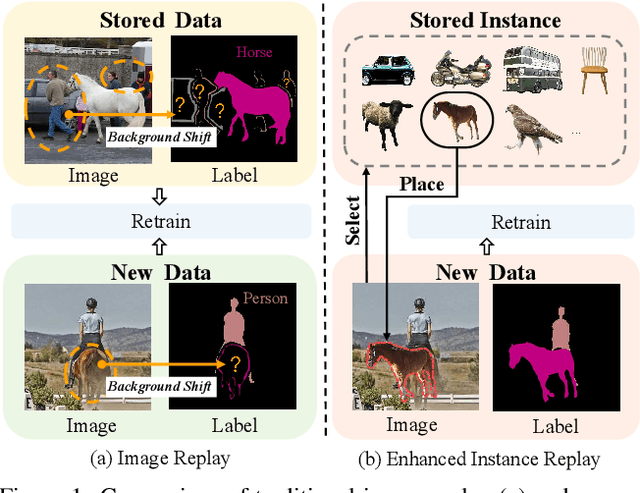
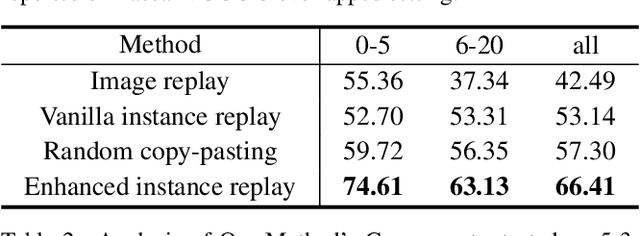
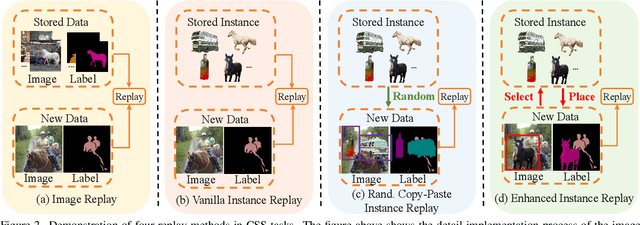
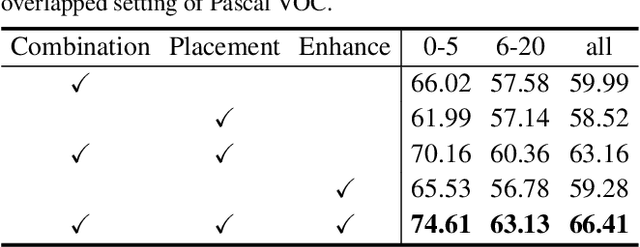
In this work, we focus on continual semantic segmentation (CSS), where segmentation networks are required to continuously learn new classes without erasing knowledge of previously learned ones. Although storing images of old classes and directly incorporating them into the training of new models has proven effective in mitigating catastrophic forgetting in classification tasks, this strategy presents notable limitations in CSS. Specifically, the stored and new images with partial category annotations leads to confusion between unannotated categories and the background, complicating model fitting. To tackle this issue, this paper proposes a novel Enhanced Instance Replay (EIR) method, which not only preserves knowledge of old classes while simultaneously eliminating background confusion by instance storage of old classes, but also mitigates background shifts in the new images by integrating stored instances with new images. By effectively resolving background shifts in both stored and new images, EIR alleviates catastrophic forgetting in the CSS task, thereby enhancing the model's capacity for CSS. Experimental results validate the efficacy of our approach, which significantly outperforms state-of-the-art CSS methods.
Casual Inference via Style Bias Deconfounding for Domain Generalization
Mar 21, 2025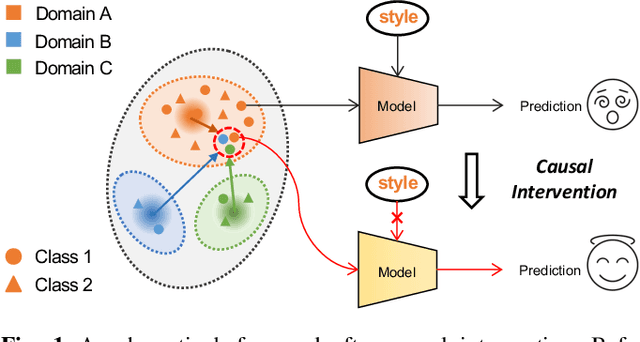
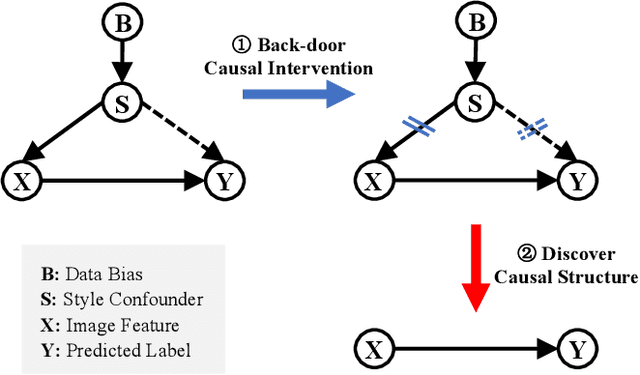
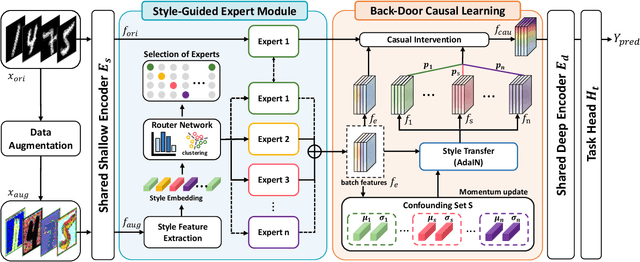
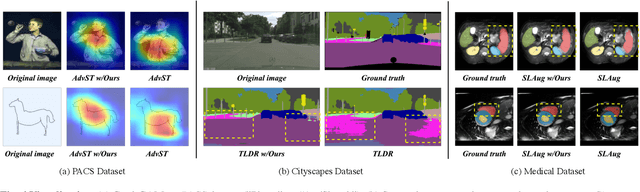
Deep neural networks (DNNs) often struggle with out-of-distribution data, limiting their reliability in diverse realworld applications. To address this issue, domain generalization methods have been developed to learn domain-invariant features from single or multiple training domains, enabling generalization to unseen testing domains. However, existing approaches usually overlook the impact of style frequency within the training set. This oversight predisposes models to capture spurious visual correlations caused by style confounding factors, rather than learning truly causal representations, thereby undermining inference reliability. In this work, we introduce Style Deconfounding Causal Learning (SDCL), a novel causal inference-based framework designed to explicitly address style as a confounding factor. Our approaches begins with constructing a structural causal model (SCM) tailored to the domain generalization problem and applies a backdoor adjustment strategy to account for style influence. Building on this foundation, we design a style-guided expert module (SGEM) to adaptively clusters style distributions during training, capturing the global confounding style. Additionally, a back-door causal learning module (BDCL) performs causal interventions during feature extraction, ensuring fair integration of global confounding styles into sample predictions, effectively reducing style bias. The SDCL framework is highly versatile and can be seamlessly integrated with state-of-the-art data augmentation techniques. Extensive experiments across diverse natural and medical image recognition tasks validate its efficacy, demonstrating superior performance in both multi-domain and the more challenging single-domain generalization scenarios.